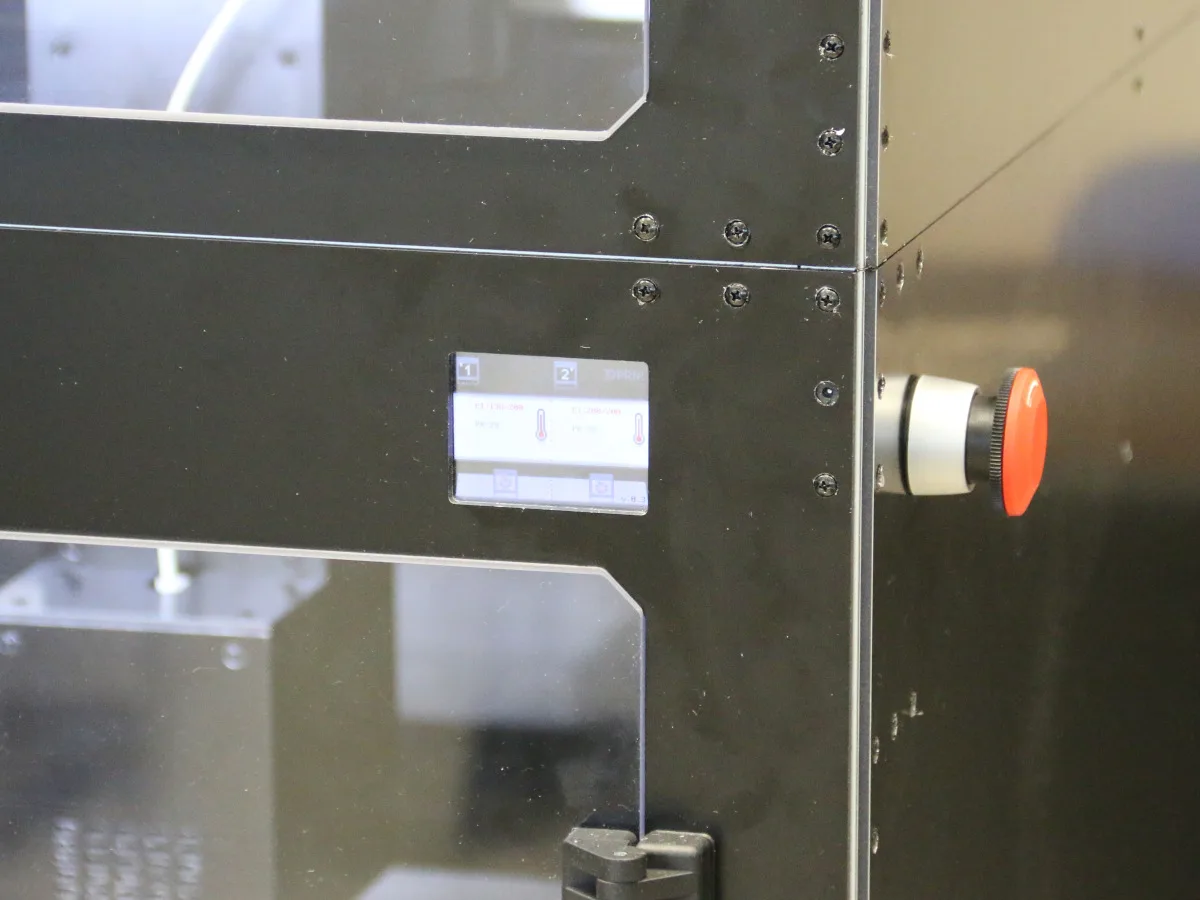
Large professional 3D printers offer exciting solutions for those who want to integrate additive manufacturing into their production processes. Technological advances have made it possible to create increasingly larger, more complete, and more functional parts, transforming 3D printers from simple prototyping tools into a true solution for numerous industrial applications.
For a company, choosing large-scale professional 3D printing means being able to work directly from a digital model and transform it into a physical object without necessarily having to resort to molds or particularly complex traditional processes. These features offer new possibilities for the creation of prototypes, customized components, accessories, models, dimensions, and industrial tools .
Product design, however, can be very different from any other field. For this reason, it’s important to acquire a large 3D model to fully understand the most important technical features and evaluate the quality that can truly contribute to improving the production process.
What is a large-format professional 3D printer?
A large-format professional 3D printer is an additive manufacturing system designed to produce objects whose dimensions exceed the usual capabilities of small-format equipment.
The process begins with a three-dimensional digital model , created using a design or engineering program. The file is then processed by preparation software, which generates the instructions the printer needs to build the object step by step.
The component is created by depositing or successively processing multiple layers of material. The result can be a functional component, a prototype, a model, or a tool intended for a specific application.
The main difference compared to a conventional printer is the production volume . Large-format systems allow you to work with considerably larger parts, in some cases reducing the need to divide an object into multiple parts.
Why do businesses need large format solutions?
Industrial companies increasingly require manufacturing flexibility . Markets change rapidly, and products may require frequent modifications, customization, or shorter development cycles.
3D printing responds to these needs because it allows you to modify the digital design and subsequently produce a new version without necessarily having to create specific tools for each modification.
When parts are large, a large-format printer offers an additional advantage: it allows you to produce larger objects in a single operation or significantly reduce the number of parts to be assembled.
This can be particularly interesting for industrial prototypes, molds, scale models and custom tooling .
Large dimensions professional 3D printer: characteristics and advantages for your home
A large-scale professional 3D printer should be evaluated based on various technical and manufacturing features. Among the key aspects companies should analyze are:
- Large build volume , ideal for producing bulky components and full-scale prototypes.
- Robust structure , necessary to maintain stability during prolonged production processes.
- High precision , particularly important for components and functional parts that must meet certain tolerances.
- Compatibility with different materials , to be able to adapt production to specific applications.
- Efficient extrusion system , capable of working with a material flow suitable for the production of large-sized parts.
- Production speed is an essential factor when the printer is used frequently in a professional environment.
- Thermal stability , particularly important for some technical materials.
- Control and preparation software that allows the correct configuration of production parameters.
- Ease of maintenance , to reduce interruptions and simplify periodic operations.
- Reliability and repeatability are critical to the continued use of the machine in an enterprise environment.
- Flexibility of use , to be able to produce different types of components based on the company’s needs.
High print volume
Print volume is probably one of the first features to analyze when choosing a large format printing machine.
However, having an extremely high volume does not necessarily mean that the printer is the best solution.
The company must first study the dimensions of the parts it routinely produces. A machine must offer sufficient space for planned projects while also ensuring margin to meet future needs.
Adequate volume can reduce the need to break a piece into separate components. This can simplify subsequent assembly and improve the object’s structural continuity.
Structure and stability
When producing large components, the stability of the 3D printer becomes particularly important.
A robust structure helps maintain the stability of the movements of the various machine components during operations that can last many hours.
Stability is also related to final quality. Small variations, which may be insignificant in a small component, can become significant when the manufactured object is large.
For this reason, a professional large-format printer must be designed taking into account not only the size of the part, but also the requirements for precision and repeatability .
3D printing materials
The ability to use different materials for 3D printing greatly increases the versatility of a machine.
Depending on the application, a company may need materials with greater stiffness, flexibility, mechanical strength, or thermal stability.
Polymers are widely used in additive manufacturing, although there are numerous variants designed for specific needs.
Before purchasing a printer, it is advisable to check which materials are compatible with the system and what conditions are necessary to process them correctly.
The choice of material should always be made taking into account the final use of the object.
Precision and quality of production
Accuracy is essential when using a professional 3D printer to produce functional components.
High precision allows you to produce parts with dimensions closer to those specified in the digital model. However, the final result depends on several factors, including the machine configuration, the material used, the object geometry, and the printing parameters.
Layer thickness can also affect surface quality. A thinner layer can allow for greater definition of certain details, although this usually means increased production times.
For this reason, the configuration must be adapted to each project, seeking a balance between quality, speed and productivity .
Reduction in productivity and time
One of the main advantages of professional 3D printing is the possibility of reducing some development times .
Creating a prototype using traditional methods can require multiple steps, tools, and processes. With additive manufacturing, some parts can go directly from digital design to production.
This makes it easier to create different versions of a product and allows for testing in the early stages of the project.
For companies, this iterative capability can be particularly useful because it allows them to identify potential problems before investing in final production processes.
Industrial applications
The applications of a large-format professional 3D printer are numerous.
In the automotive industry, it can be used to create prototypes, components and specific tools.
In engineering, it can facilitate the production of custom tools, fixtures, jigs and components .
In architecture, it allows the creation of large models and prototypes.
In the mechanical industry, it can be used to produce functional prototypes and certain components.
It can also be useful in research centers, design offices, and companies that work with customized products or limited series.
Large-scale prototyping
One of the most interesting applications is large-scale prototyping .
When developing a large-scale product, simply visualizing it on a screen may not be enough. A physical model allows you to verify aspects related to size, ergonomics, assembly, and interaction between the various components.
3D printing allows for the rapid creation of a physical representation and subsequent modification of the design if problems are detected.
This system promotes a development process based on experimentation and continuous improvement .
Production of molds and equipment
Companies can also use additive manufacturing to create custom molds, patterns, fixtures, and tooling .
In some cases, producing these solutions using conventional methods can be a more time-consuming and expensive process.
3D printing allows the direct development of a tool adapted to production needs.
This possibility is particularly interesting when small series or specific solutions are needed , since the digital file can be modified with relative ease.
Customization and production on request
Customization is another major advantage .
A 3D printer can produce different components from different digital files, without the need to modify a conventional production line.
This facilitates the production of custom components and can be useful for companies that work on specific orders.
On-demand manufacturing can also reduce the need to stock large quantities of certain components, especially when dealing with slow-moving components or custom products.
Waste reduction
Additive manufacturing progressively deposits material to build the part, rather than necessarily starting from a block that must then be machined.
This may allow for more efficient use of the material in certain applications.
However, the actual level of use will depend on the geometry, required supports, material and parameters used.
Design optimization can also help reduce material consumption without compromising necessary functional characteristics.
The role of software in professional 3D printing
Preparation software is a critical component of the additive manufacturing process.
Before printing, you need to convert your 3D model into instructions that the machine can execute.
The user can configure parameters such as layer height, speed, infill, media, temperatures and various production-related characteristics.
Proper preparation optimizes the process and can help reduce both printing times and material consumption.
In a professional setting, having the right control tools makes it easier to manage more complex projects.
Maintaining a large-format 3D printer
A machine used in a professional environment requires regular maintenance .
Cleaning, checking components, calibrating and replacing worn parts are important operations to maintain stable performance.
Ease of maintenance should be part of the selection criteria.
A technically advanced but difficult-to-maintain printer can cause unnecessary downtime. Therefore, it’s advisable to evaluate component accessibility, spare parts availability, and technical support .
3DPRN and professional additive manufacturing
In the field of professional additive manufacturing solutions, 3DPRN develops systems for companies that need to use 3D printing in various industrial applications.
Choosing a professional solution should always start with the company’s specific needs. The type of components, materials, size, frequency of use, and required precision are essential factors in determining the most suitable configuration.
The printer should be considered as an integral part of a complete production process , and not simply as a stand-alone machine.
How to calculate return on investment
Before investing in a large-format professional 3D printer, it is advisable to also analyze the potential return on investment .
To this end, it is possible to compare the current costs related to the production of prototypes, tools and certain components with the expected costs using additive manufacturing.
Factors such as time savings, reduction of outsourcing operations, the possibility of in-house production and the ability to produce custom components must also be considered.
In many cases, the value of a 3D printer depends not only on the cost per part, but also on the speed of response it can offer to engineering and manufacturing departments.
The large-scale professional 3D printer offers businesses a combination of flexibility, customization, and production capacity that can be adapted to numerous industrial applications.
Large print volume , precision, compatibility with different materials, stability, speed and ease of maintenance are some of the features to analyse before making an investment.
Its applications range from large-scale prototyping to the production of molds, tools, models, and customized components.
Large-format additive manufacturing enables a direct connection between digital design and physical production and can help reduce some development times, simplify processes, and increase companies’ autonomy.
To fully leverage these benefits, the choice must be based on the specific needs of each project. A properly selected large-format professional 3D printer can therefore become a strategic tool for companies looking to move toward more flexible, digital, and efficient production .


